
Intent
At Enderby Road Infant and Nursery School, we strive to support all our all our pupils to become fluent, enthusiastic writers who are able to communicate their ideas clearly through written language.
Our aims are for pupils to:
- Develop a comfortable, neat handwriting style
- Apply phonic knowledge to spell accurately
- Be able to compose grammatically correct sentences by orally rehearsing at first
- Be able to apply and bring together transcription and composition skills to be able to become fluent writers, able to communicate clearly through written language
We are committed to ensuring that every child makes a strong start and is able to experience early success and find enjoyment in writing.

Implementation
Our writing curriculum is designed to ensure that pupils are taught the necessary knowledge and skills they need in order to become fluent writers and are given sufficient opportunity to practise and embed these skills, before they are expected to apply them to extended writing tasks. Our approach to writing is underpinned by our ‘Progression of Writing Skills’ document, which clearly sets out the transcription skills (spelling and handwriting) and composition skills (articulating ideas and structuring them in speech, before writing) which are to be taught from Nursery through to Year 2. Transcription and composition skills are taught in isolation at first, until a good level of fluency is achieved. Once the children are ready, they are then supported to bring together and apply their skills to write for different purposes.
Transcription: Handwriting
At Enderby Road, we understand that it is essential for our children to have well developed fine and gross motor skills in order to be ‘ready to write’. Our Early Years environment has been designed in such a way that opportunities for movement, and the development of fine and gross motor skills, are everywhere. Our children enjoy climbing on the climbing frame, swinging from the monkey bars, riding bikes, painting giant canvases, building and completing obstacles courses, and many other physical activities within their play. Our Early Years children begin every day at school with an ‘active start’ – running laps of our playground, building fine motor strength with ‘dough disco’ and developing their gross motor skills with a ‘squiggle while you wiggle’ session. ‘Squiggle while you Wiggle’, created by Shonette Bason-Wood, is a carefully sequenced programme of movement, which incorporates dance and music to physically prepare children for writing.
In Reception, pupils are introduced to correct letter formation within their Little Wandle phonics lessons. We use the Little Wandle visuals, alongside the simple rhymes and phrases to help them remember the correct formation of graphemes. Opportunities to practise formation in different ways, for example with a paintbrush, a finger in the sand or chalks on the ground are built into provision planning within the environment.
Once they are physically ready, we begin to teach pupils to correctly form letters, using pencil and paper. We use the ‘Happy Handwriting’ scheme to support us in delivering high quality, discrete direct teaching. Happy Handwriting is carefully sequenced to develop pupils’ handwriting skills, and supports correct pencil grip and posture, as well as knowledge of ‘letter families’. As the scheme progresses through KS1, pupils begin to use joins, supporting fluency and speed of writing.
Transcription: Spelling
Daily phonics lessons in Reception and Year 1
Our children are taught high quality phonics lessons for 30 minutes a day, with additional GPC and blending practise throughout the day. Each Friday the weeks' learning is reviewed to support and develop fluency and rapid recall.
Children make a strong start in Reception: teaching begins in Week 2 of the Autumn term. We follow the Little Wandle Letters and Sounds Revised expectations of progress:
- Children in Reception are taught to read and spell words using Phase 2 and 3 GPCs and words with adjacent consonants (Phase 4) with fluency and accuracy.
- Children in Year 1 review Phase 3 and 4 and are taught to read and spell words using Phase 5 GPCs with fluency and accuracy.
In the Autumn Term of Year 2, children complete the Little Wandle ‘bridge to spelling’ programme before progressing onto Little Wandle Spelling. These sessions are highly structured and ensure that all spelling requirements of the national curriculum are explicitly taught, and that pupils have sufficient opportunities to practise and embed these, ready to apply them to writing throughout the curriculum.
Composition
As an Infant and Nursery School, Enderby Road recognises the importance of early language development and how this will underpin a child’s development as they progress through school – making oracy one of our CORE drivers. This development is crucial for a child to succeed in all areas of the curriculum and a good secure language base will enable them to thrive. One of the ways that we support pupils oracy skills, is through our ‘Drawing Club’ sessions.
'Drawing Club’ is an approach created by Greg Bottrill, which ‘immerses children into a world full of imagination and wonder’. It combines many different areas of learning, including reading and maths, but is primarily designed to support the development of oracy and mark making skills. At Enderby Road, we have been influenced by Greg Bottrill’s ideas and have built upon them to create our own, bespoke version.
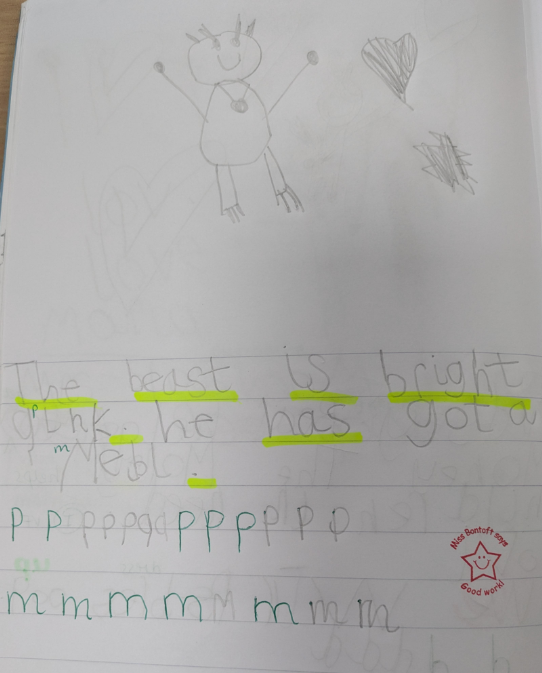
Drawing Club begins in Reception. Each week, the children share a quality story book, and are set daily ‘drawing and talking’ challenges linked to the book. These challenges can include a focus on specific characters, settings, plot points, or an ‘invention’ task in which the children are encouraged to use their imagination to create something new. Children are invited to ‘drawing club’ in small groups and are encouraged to respond to the daily challenge, using talk and drawing as a vehicle to help them to communicate their ideas. Pupils are then supported to orally rehearse a single sentence to accompany their drawing. Children are taught to use double sided counters to represent each word as a visual representation of their composed sentence.
As pupils transcription skills progress, the double sided counters are used as a ‘bridge’ between orally composing a sentence and writing it down. Children apply their handwriting and spelling skills to write the word and turn over the counter when they have done so. They are then reminded that they must include a ‘finger space’ before writing the next word in the sentence. Once all of the counters are turned, they know that they need to include a full stop.
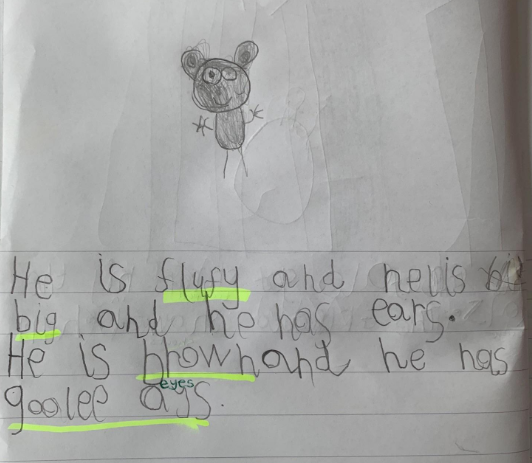
This structure for composing and transcribing sentences is carried into KS1. As the children’s knowledge and skills develop, their sentences become more complex and they begin to sequence sentences to form short narratives. Eventually the use of double sided counters is no longer required as pupils are able to write fluently.
A crucial part of our ‘drawing club’ lessons in KS1 is modelled writing in which teachers show children how to bring together and apply their transcription and composition skills to write sentences. We use visualisers to clearly model the physical writing process to the pupils and use ‘talking out loud’ to show children our inner thought processes. Pupils are taught to use different writing features, as indicated on the national curriculum, (SPaG) within the modelled writing element of the lesson. We use visuals to ‘dual code’ these writing features and use these to support the children to include them in their own writing and as a tool for self-assessment.
Impact
At Enderby Road Infant and Nursery School, the quality teaching of writing results in:
- Pupils who are equipped with the essential transcription skills needed to write fluently
- Pupils who are able to use their own imagination to invent new ideas and are confident to discuss this with others
- Pupils who know what they want to write and can orally rehearse this
- Pupils who make ambitious vocabulary choices
- Pupils who see themselves as writers, for both pleasure and purpose
- Pupils who are able to talk about specific SPaG features within their own writing and the writing of others
- Pupils who take pride in their learning, and enjoy sharing their writing with their teachers and peers

|
ERIS - English Policy | [pdf 191KB] |

|